Why deals go cold between discovery call and proposal
Most discovery calls end without what the proposal needs. Here is what goes missing, what the wait costs, and how to close the gaps before you hang up.
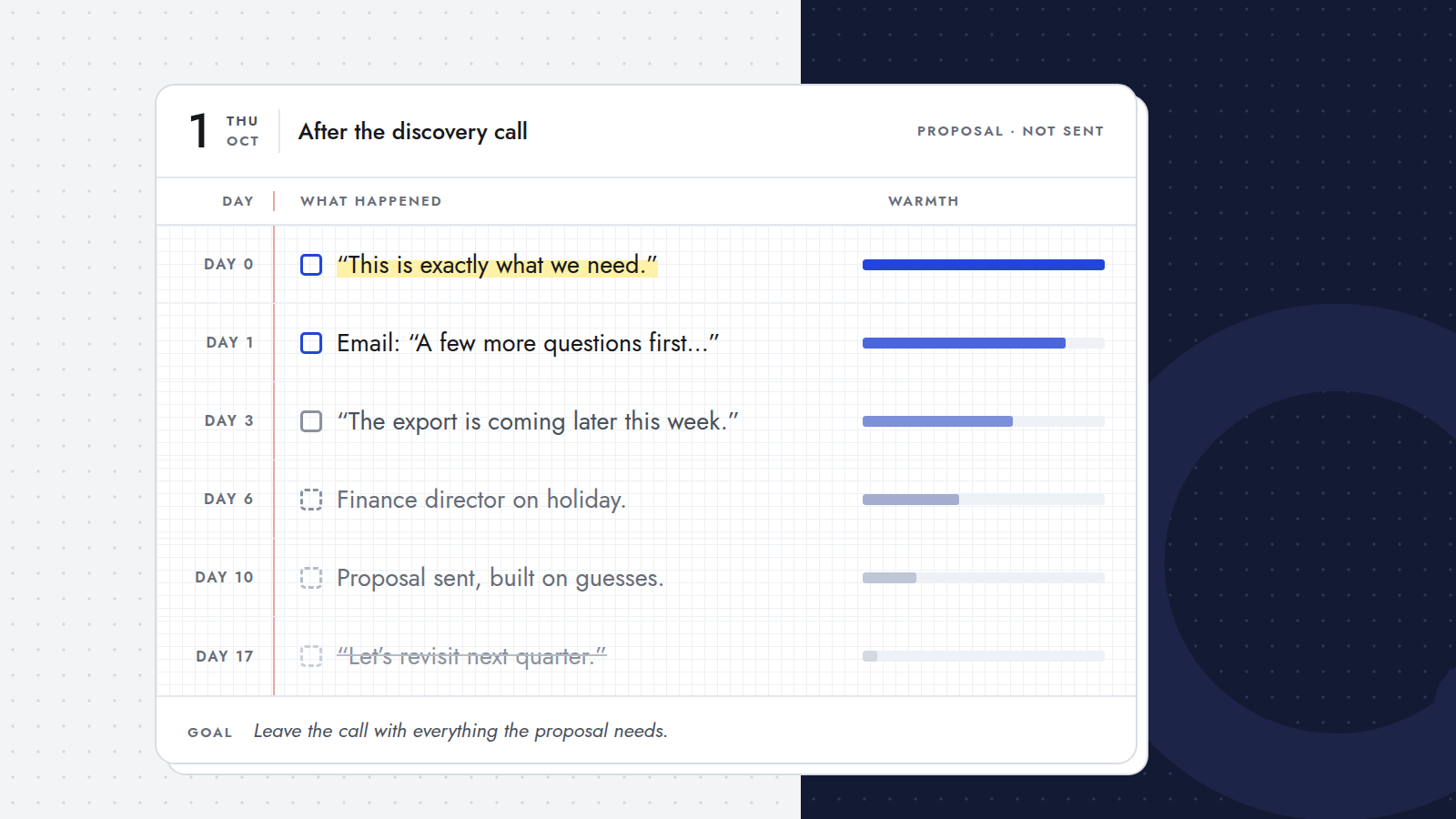
Most deals don't die in the discovery call. They die in the days after it. You go in with a clear goal, the call goes well, and you hang up with a warm prospect and a promise to "send something over". Then you notice what you don't have: the volumes, the scope, the name of the person who signs. The proposal can't go out yet, so you send an email with questions instead, and while you wait for answers, the lead cools down.
This post is about that gap: the information that goes missing in a good call, what waiting costs you, and how to close the gaps while the client is still on the line.
Key takeaways
- A deal usually goes cold in the days between the discovery call and the proposal, not in the call itself.
- The cause is missing information: data, scope, the decision maker, budget, deadline or success criteria that the call didn't pin down.
- Speed matters: in a study of 1.25 million leads, firms that followed up within an hour were nearly 7 times as likely to qualify the lead as firms that waited an hour longer.
- The fix is to leave the call with everything the proposal needs, by working from a checklist and asking for the missing pieces before you hang up.
Why is a discovery call often incomplete?
Almost everyone who runs discovery calls prepares a goal. "Understand how they handle orders today and what a pilot would need." It's a good goal. The trouble is that a conversation doesn't follow your goal. The client tells a story, you follow it, and forty minutes later the story is finished but your list isn't.
A discovery call is incomplete when it ends without the information you need to write the proposal. These are the gaps that come up most often:
- The data comes "after the call". "I'll send you last month's order export." It arrives three days later, or it arrives in a different format, or only half of it arrives. Without it you can't size the work, so you can't price it.
- The scope is still soft. You know the main process, but not the edges. Does it need to handle returns? Credit notes? The three customers who send orders as photos? Every "probably" in the scope becomes a risk you either price in or ask about later.
- The person who decides wasn't in the call. You spoke to the operations manager, who is enthusiastic. But the budget sits with the finance director, who has never heard of you and wasn't there when the problem was explained.
- Nobody said a number. No budget range, no cost of the problem today. So you don't know whether to propose a small pilot or the full rollout, and you guess.
- "When" was never asked. Is there a deadline, like a peak season or a system migration? Without it your proposal has no urgency, and neither does their answer.
- Success wasn't defined. What would make the pilot a success for them? Fewer errors, fewer hours, faster orders? If you don't know, your proposal promises the wrong thing.
- IT and security haven't seen it. Access to their systems, a security questionnaire, a data processing agreement. These can take weeks, and they often only come up once the proposal is on the table.
Each gap on its own is small. Together they mean the proposal can't go out the same day, and that is where the delay starts.
How much does waiting cost?
There is little research on proposals specifically, but there is solid research on how fast interest decays once a buyer has raised their hand:
- In a study of 1.25 million sales leads at 42 companies, firms that contacted a lead within an hour were nearly 7 times as likely to qualify it as firms that waited even one hour longer, and more than 60 times as likely as firms that waited 24 hours or more. The average response time in the study was 42 hours. (Harvard Business Review, 2011)
- An earlier analysis of more than 15,000 leads and 100,000 call attempts found that the odds of reaching a lead were 100 times higher when the first call came within 5 minutes instead of 30, and the odds of qualifying it 21 times higher. (Lead Response Management study, InsideSales.com with Dr. James Oldroyd, 2007)
- B2B buyers spend only about 17% of their buying time meeting with potential suppliers, and that time is split across every supplier they talk to. The rest goes to their own research and to meetings among themselves. (Gartner, the B2B buying journey)
These studies measured the first response to an inbound lead, not the proposal after a discovery call. But the mechanism is the same. Right after a good call, the client is thinking about their problem and about you. A week later they are thinking about whatever landed on their desk since, and you are back to being one supplier among several.
How does a warm lead go cold?
It rarely happens in one moment. It usually looks something like this:
- Day 0. A good call. The client says "this is exactly what we need".
- Day 1. You email the questions you should have asked, and a request for the data.
- Day 3. Half an answer. The export is coming "later this week".
- Day 6. You follow up. The contact is busy; the finance director is on holiday.
- Day 10. You finally send the proposal, built on a few guesses.
- Day 17. "We'll look at it next quarter."
Nobody said no. The energy of the call simply ran out before the proposal arrived.
How do you close the gaps before you hang up?
The fix is not to write proposals faster. It is to leave the call with everything the proposal needs. A few habits that help:
- Turn your goal into a checklist of what the proposal needs. Not "understand their process", but: volumes, exceptions, systems, decision maker, budget range, deadline, success criteria. You can tick off a list during a call; you can't tick off a goal.
- Ask for the data during the call, not after it. "Could you share your screen and show me last month's export?" gets you the numbers today instead of a promise.
- Ask who else decides, and how. "Who else on your side needs to sign off before you can start a pilot?" is one of the most useful questions in any discovery call.
- Agree on the next step before you hang up. A date for the proposal and a date to walk through it together, in both calendars.
- Send a recap the same day with what you agreed and the one or two points that are still open, and who owes what by when.
The hard part is doing all of this while you are also listening, building rapport and following the client's story. That is exactly the moment your checklist slips.
How does Querly help?
Querly is a live call copilot that helps with exactly this. Before the call you write your goal or checklist. During the call Querly listens on your own laptop and, each time the client finishes speaking, shows you the one question that fits the moment and moves your checklist forward, along with the points that are still open. No bot joins the meeting, so the call stays a conversation between you and your client.
The result is fewer "I'll send it after the call" moments, and a proposal that can go out while the client is still warm.
Frequently asked questions
What should you know before you write a proposal after a discovery call?
At least the volumes or size of the work, the scope and its exceptions, who decides and how, a budget range or the cost of the problem today, the deadline, and what success looks like for the client. Without these, a proposal is built on guesses.
How soon should you send a proposal after a discovery call?
As soon as you can, ideally the same day or the next. Research on sales leads shows interest drops sharply by the hour: firms that responded within an hour were nearly 7 times as likely to qualify a lead as firms that waited one hour longer (HBR, 2011).
Why do leads go cold after a good sales call?
Because the next step depends on information that wasn't collected during the call. While you wait for data, answers or the decision maker, the client's attention moves to other work and other suppliers.
How can you avoid a follow-up email full of questions?
Turn your goal into a checklist of what the proposal needs, ask for data during the call, find out who else decides, and book the next step before you hang up. A live call copilot like Querly can show you the question that fills the next gap while the client is still talking.
Want to see which questions you would have been handed in one of your own calls? Replay a past call from a notetaker transcript; it's free and we don't keep the transcript. Or get early access: the first invites go out in December.