45 discovery call questions for a proposal-ready call
45 discovery call questions that get you what a proposal needs: problem, scope, data, decision makers, budget, timing and success. Plus what research says.
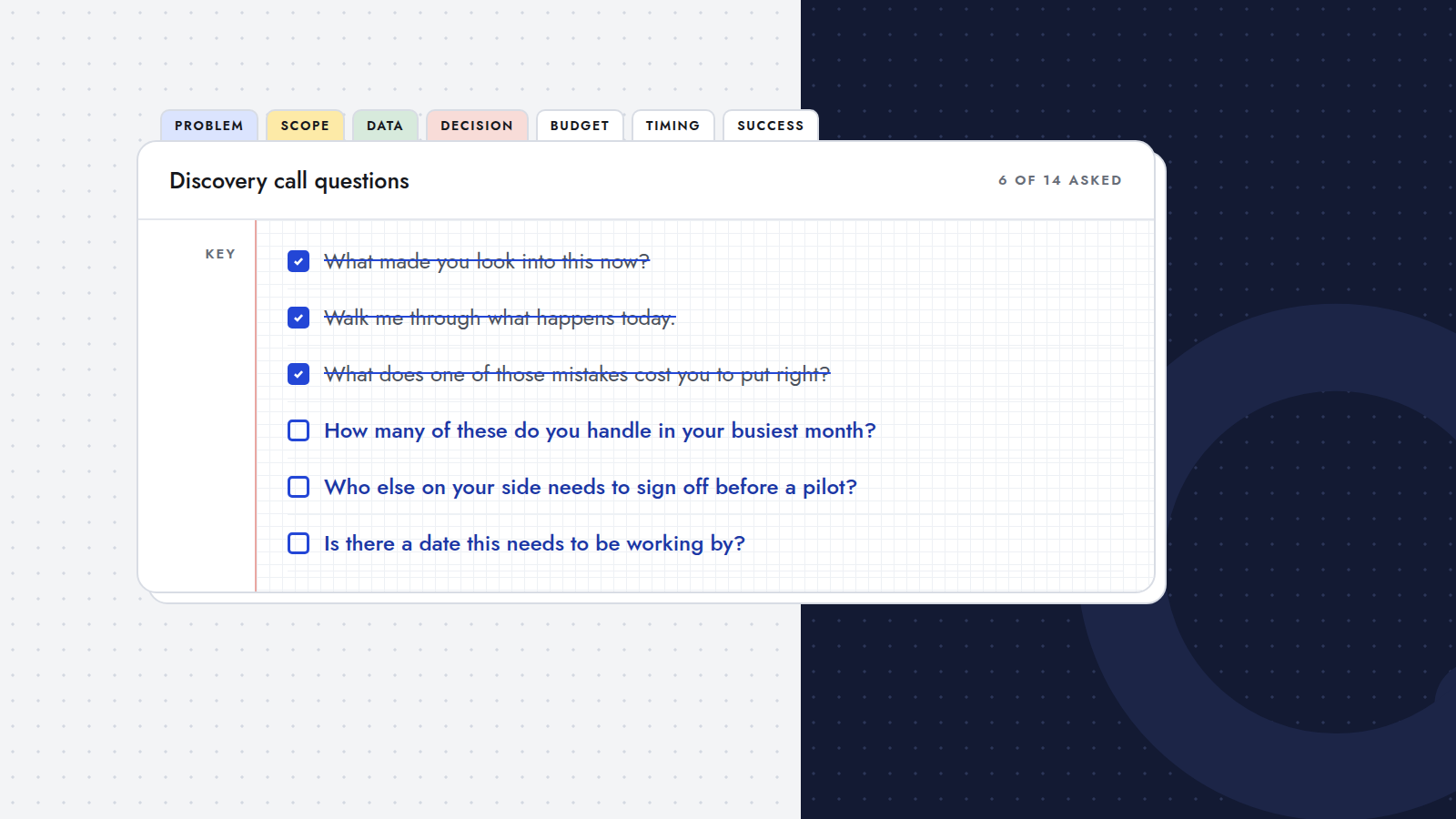
The best discovery call questions are the ones that leave you able to write the proposal the same day. That means hanging up with seven things: the problem and its cost, the scope, the data, who decides, a budget range, the deadline and what success looks like. (Why each of those holds a proposal up is the subject of why deals go cold between discovery call and proposal; this post is the toolkit.) Below are 45 questions grouped by those seven, with when to ask them and how to keep the call a conversation.
Key takeaways
- Group your questions by what the proposal needs, not by what you want to tell the client.
- Ask fewer questions than you think, and spread them through the call instead of opening with a list.
- The questions that move bigger deals are about consequences: what the problem costs and what happens if nothing changes (the core of Neil Rackham's SPIN research).
- You won't ask all 45. Pick the 11 to 14 that fill the gaps for this client, and keep the rest as follow-ups.
How many questions should you ask in a discovery call?
Fewer than you think, and better timed. Gong analyzed 519,000 recorded discovery calls and found that 11 to 14 questions correlated with the most successful calls; fewer and the call wasn't thorough enough, more and it started to feel like an interrogation. The same analysis found that top sellers spread their questions evenly through the call, while average sellers front-loaded them at the start (Gong).
Listening matters as much as asking. In Gong's data, the highest-converting B2B sales calls had a talk-to-listen ratio of about 43:57: the seller talked less than half the time (Gong).
So treat the list below as a menu, not a script. Before the call, pick the questions that match the gaps you expect. During the call, ask each one when the conversation reaches it.
Which questions matter most in bigger deals?
In the 1970s and 80s, Neil Rackham and the Huthwaite research team observed 35,000 sales calls in more than 20 countries over 12 years, and published what they found in SPIN Selling in 1988 (Wikipedia: Neil Rackham). Their framework sorts questions into four kinds:
- Situation: facts about how things work today.
- Problem: what is difficult, slow or going wrong.
- Implication: what those problems cause: cost, risk, lost customers, stress.
- Need-payoff: what solving it would be worth.
Their central finding was that in larger sales, successful calls didn't stop at situation and problem questions. They moved on to implications and payoff, so the client put the size of the problem into their own words. That is also what makes a proposal easy to justify later: the business case comes from the client, not from you.
In the list below, the questions about cost and consequences are the implication questions. Don't skip them.
1. What is the problem, and what does it cost?
These give you the "why now" and the number your price will be compared to.
- What made you look into this now, rather than six months ago?
- Walk me through what happens today, from the first step to the last.
- Where does it go wrong most often?
- What does one of those mistakes cost you to put right?
- How much time does your team spend on this in a normal week?
- What happens if nothing changes in the next year?
- Who feels this problem most: your team, your customers, or you?
- What have you already tried, and why didn't it stick?
Ask them when: early, but after the client has told their story. Questions 4 and 6 work best right after the client describes a specific incident.
2. What exactly is in scope?
These pin down the edges, so you don't have to price in guesses.
- If we could only fix one part of this, which part would it be?
- Which cases are the exceptions? The ones that always need a person?
- Are there parts of the process you want to keep exactly as they are?
- Which other teams or systems does this touch?
- What would be a good first step, small enough to try in a few weeks?
- Is there anything that sounds related but should stay out of this project?
Ask them when: as soon as the client starts describing a solution. Pinning down the edges early saves you a round of emails.
3. What data and access will you need?
These turn "I'll send it after the call" into numbers you have today.
- How many of these do you handle in a normal month? And in your busiest month?
- Could you share your screen and show me what one of these looks like?
- Where does this information live today: which system, which spreadsheet?
- Who could give us access to that system, and what would they need from us?
- Do you have an example we could use to test with?
- Are there security or privacy requirements we should know about before we propose anything?
Ask them when: the moment the client mentions a system or a document. "Could you show me?" beats "could you send me?".
4. Who decides, and how?
The person in the call is often not the person who signs.
- Who else on your side needs to sign off before you can start a pilot?
- How have you made similar decisions in the past?
- Who will use this day to day, and how involved do they want to be?
- Is there anyone who might have doubts about this? What would they worry about?
- Would it help if we walked your colleague through it together?
- What does your side need to see in a proposal to say yes?
Ask them when: after the client has agreed the problem is worth solving. Asked too early, it can feel like you're going over their head.
5. What budget are we working with?
A budget question isn't awkward when it follows the cost of the problem.
- Have you set aside a budget for this, or would this be a new decision?
- When you think about what this costs you today, what would a sensible investment look like?
- Would you rather start with a small pilot or plan the full rollout from the start?
- Are there budget cycles or fiscal-year dates we should plan around?
- How do you usually compare options like this: price, time to value, or risk?
Ask them when: right after the cost questions in group 1. The number the client just gave you is the context for the budget.
6. When does it need to happen?
A deadline gives your proposal a date and the client a reason to answer.
- Is there a date this needs to be working by?
- What happens if it isn't ready by then?
- Are there busy periods when your team can't take on anything new?
- How long do decisions like this usually take on your side?
- What would you want to have done by the end of next month?
Ask them when: after scope, before you end the call. The answers set the date on your proposal.
7. What does success look like?
These make sure your proposal promises what the client actually wants.
- Six months from now, what would make you say this was worth it?
- What would you measure to know it's working?
- What would you need to see after the first few weeks to continue?
- What would make this a failure, even if it technically works?
- Who else needs to agree that it was a success?
Ask them when: near the end of the call, as a summary of everything before it.
Closing the call: what are the next steps?
The last few minutes decide whether the proposal can go out the same day.
- Is there anything I didn't ask that I should have?
- What would you like to see in the proposal?
- Shall we find a time now to walk through the proposal together?
- Is there anything I should send you before then?
For what to do right after the call, see the discovery call recap email.
How do you ask all this without it feeling like an interrogation?
- Follow the client's story. Ask the next question from what they just said, not from the top of your list.
- Spread the questions. Don't open with ten questions in a row. Ask one, listen, then follow up.
- Use their words. "You said the export takes a day. What happens to orders during that day?"
- Ask for examples, not opinions. "Can you show me the last one that went wrong?" gives you facts.
- Let silence work. After a big question, wait. The second half of the answer is often the useful part.
The hardest part is timing. The right moment for a question is right after the client says something that opens it, which is also the moment you are busiest listening.
Can software pick the right question for you?
It can pick the moment. Querly, a live call copilot, takes your goal or checklist and, each time the client finishes speaking, shows one question that follows from what they just said and fills a gap that is still open. It is the "spread your questions through the call" advice, done for you while you listen. You still ask it in your own words.
To see which of these 45 your last call needed, replay it from a notetaker transcript.
Frequently asked questions
What are the most important discovery call questions?
The ones about consequences: what the problem costs today and what happens if nothing changes. They give you the business case for your proposal. After those, the most useful question is who else needs to sign off, because the decision maker is often not in the call.
How many questions should you ask in a discovery call?
Around 11 to 14. Gong's analysis of 519,000 discovery calls found that range correlated with the most successful calls, and that spreading the questions through the call worked better than asking them all at the start.
How do you ask about budget in a discovery call?
Ask right after the client has described what the problem costs. "When you think about what this costs you today, what would a sensible investment look like?" connects the budget to their own numbers, which makes it a natural question rather than an awkward one.
What is the SPIN method for discovery questions?
SPIN stands for Situation, Problem, Implication and Need-payoff questions. It comes from Neil Rackham's research on 35,000 sales calls, which found that successful calls in larger sales went beyond facts and problems to their consequences and value.