The discovery call recap email: a template that works
A recap email sent the same day turns a good discovery call into a next step. A template to copy, a worked example, and what to put in it.
A discovery call recap email is a short email you send the same day, confirming what the client told you, what you agreed, what is still open and what happens next. Done well, it does three things at once: it shows you listened, it turns vague promises into dated commitments, and it collects the last pieces your proposal needs while the client is still warm. Below is a template you can copy, a worked example, and the mistakes that make recaps get ignored.
What should a discovery call recap email contain?
Five short blocks, in this order:
- Thanks and the reason for the call, in one sentence.
- What you heard: the problem and its cost, in the client's words and numbers.
- What you agreed: the direction, the scope, the first step.
- What's still open: each point with an owner and a date.
- The next step: one concrete action with a date, ideally already in both calendars.
That's it. No attachments, no pricing, no case studies. The recap is a mirror of the call, not a sales pitch.
A template you can copy
Subject: Recap: [topic] and next steps
Hi [name],
Thanks for walking me through [topic] today.
What I heard. [Problem in their words.] Right now that means [cost or effect, with their number]. It matters now because [their reason for acting now].
What we agreed. Start with [scope of the first step], leave [what's out of scope] for later. Success after [period] means [their success criterion].
Still open. – [Item] – [who] by [date] – [Item] – [who] by [date]
Next step. I'll send the proposal on [date], and we'll walk through it together on [date and time] with [decision maker].
Anything I got wrong or missed? Just reply to this email.
[Your name]
A worked example
Here is the template filled in for a fictional discovery call about automating an order desk:
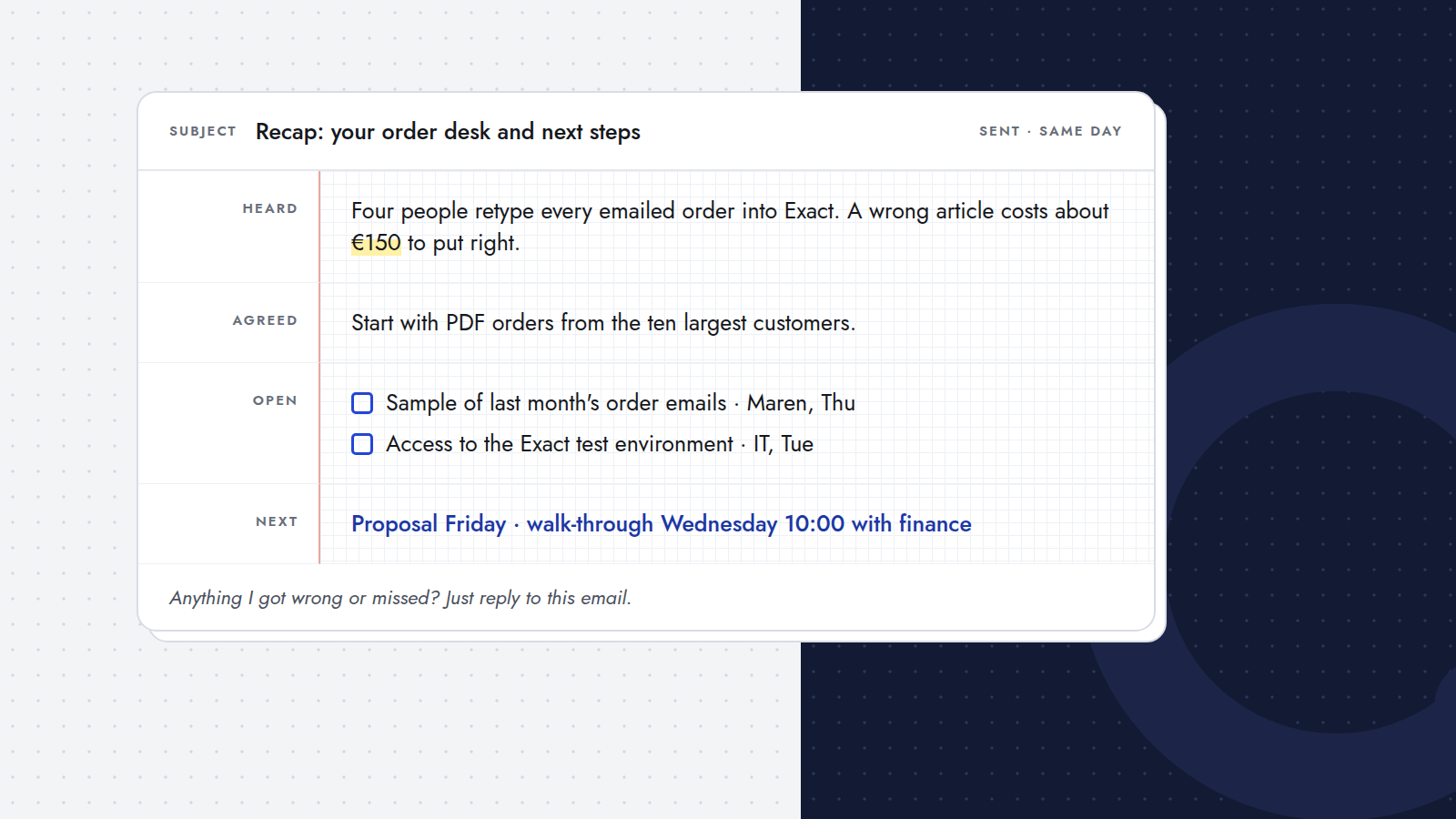
Subject: Recap: your order desk and next steps
Hi Maren,
Thanks for walking me through the order desk today.
What I heard. Your team of four types every emailed order into Exact by hand, and in the busy months orders wait a day or two. You estimated that wrong article numbers cost around €150 each to put right once the return and credit note are done. It matters now because the autumn peak starts in eight weeks.
What we agreed. Start with the PDF purchase orders from your ten largest customers; leave returns and phoned-in orders for later. Success after four weeks means orders from those customers are in Exact within an hour, without retyping.
Still open. – A sample of last month's order emails – you, by Thursday – Read access to the Exact test environment – your IT partner, by next Tuesday
Next step. I'll send the proposal on Friday, and we'll walk through it together next Wednesday at 10:00 with Pieter from finance.
Anything I got wrong or missed? Just reply to this email.
Joris
Notice what it does: every number came from the client, every open point has a name and a date, and the decision maker is already invited to the next step.
Why send a recap email at all?
Because the call is fresher in your mind than in theirs. An hour after the call the client is in their next meeting. A day later they remember that it went well, but not the three things they promised to send. A recap email is how the details survive.
It also works on commitment. Robert Cialdini's Influence (first published in 1984) describes commitment and consistency as one of the basic principles of persuasion: people want to act in line with what they have said before (Wikipedia: Influence). A recap that repeats the client's own words ("you mentioned the order desk spends about two days a week retyping orders") is a gentle reminder of what they already agreed was a problem.
And it keeps the pace. Interest fades by the hour after a call; we looked at the research on that in why deals go cold between discovery call and proposal. A recap that lands the same afternoon arrives while the call is still on the client's mind, and gives them something easy to reply to.
What makes a recap email work?
- Send it the same day. Within a few hours is best. The next morning is the latest.
- Use their numbers. "Around €150 per wrong article" is more convincing than any benefit you could write.
- Name the decision maker. If someone else signs, the recap should make them part of the next step, not an afterthought.
- Give every open point an owner and a date. "We'll need some data" gets forgotten; "a sample of last month's emails, you, by Thursday" gets done.
- Make the next step specific. A date and time, already in the calendar, beats "let me know when suits you".
- Keep it readable on a phone. Short blocks, bold labels, no attachments.
- Invite corrections. "Anything I got wrong?" makes it easy to reply, and a reply keeps the conversation going.
What are the most common mistakes?
- Waiting until the proposal is ready. The recap is what makes the proposal fast. Send it first.
- Summarizing everything. It's not the minutes. Pick what matters for the decision.
- Pitching. Adding features, case studies or pricing turns a mirror into an advert.
- Vague open points. "Some questions about your systems" leads to another email round.
- No next step. Ending with "looking forward to hearing from you" hands the momentum to the client.
What if the call left too many gaps?
Then the recap turns into a list of questions, and the proposal waits for answers. That's the most common reason recaps get long. The fix is upstream: leave the call with fewer open points. Turn your goal into a checklist before the call, and ask the missing questions while the client is still on the line. Our list of 45 discovery call questions is grouped by exactly the gaps that end up in recap emails: scope, data, decision makers, budget, timing and success.
That is also where Querly comes in. Every open point it helps you close during the call is one line less in the "Still open" block, and one email round less before the proposal. If you want to see how many gaps your last call left, replay it.
Frequently asked questions
When should you send a recap email after a discovery call?
The same day, ideally within a few hours, and at the latest the next morning. By then the client has had other meetings, and the details of your call start to blur.
What should a discovery call recap email include?
Five parts: a one-line thanks, what you heard (the problem and its cost in the client's words), what you agreed, what is still open with an owner and a date for each point, and one concrete next step with a date.
Should you include pricing in a recap email?
No. The recap confirms what you heard and agreed. Pricing belongs in the proposal, where it can be tied to the scope and to the value the client described.
How long should a recap email be?
Short enough to read on a phone in under a minute: five short blocks, roughly 120 to 200 words. If it gets much longer, the call probably left too many open points.